

8.0/10
Shogun (1975) Chapters Prologue–35
Despite the massive success of FX’s Shogun, I confess to being somewhat lukewarm till recently about reading the book. After all, with most major reviews harping on the revisionist tendencies of the new show, with the perspectives of Japanese society and the Japanese characters being elevated over the 1980 series’s more restricted focus on Blackthorne, it was easy to buy, to a point, the conventional media narrative.
Thisnarrative said that 1975’s Shogun was cringey orientalist schlock, the sort of white savior story that pleased American audiences in the 70s but would play poorly today. Indeed, despite winning 14 Emmys in 1980, the original adaptation performed poorly in Japan for its numerous, sometimes blatant, historical inaccuracies. That said, while the trope of the (usually white) foreigner who “becomes one with Japan” tends to provoke reflexive outrage in the Western press, Japanese audiences have often demonstrated a willingness to engage with Western depictions of their culture if these are crafted carefully and with respect.
A Surprising Classic
This was true of The Last Samurai and Ghost of Tsushima, two American exports that performed extremely well in Japan despite no small amount of handwringing from Western critics about cultural appropriation. And it is true of Shogun, which arguably perfected the genre of what might be called the ” BigMac jidai geki”, or some other weird twist on Sergio Leone’s infamous “Spaghetti Westerns”. But be that as it may, the original Shogun belongs to an earlier age, one less politically correct and more slipshod in regards to accuracy. Is it the racist monstrosity it’s made out to be? Is it even worth reading?

The answer to those questions is no, and yes, respectively. By and large, Shogun is a blast, an incredibly crafted page-turner that highlights, expands upon, and deepens most plot lines and characterization found in FX’s adaptation. Unlike the 1980 show, which was vastly simplified for American audiences and featured no translated Japanese dialogue, the novel mirrors the ensemble perspective adopted in the 2024 show, with as much time being given, to Mariko, Toranaga, Yabushige, and the internal politics of the realm as to Blackthorne’s small part in it. Like any good source material faithfully adapted to film or television, Shogun the novel displays the genius that FX’s Shogun sprang from, and ultimately exists in dialogue with its filmed version, each accentuating the other’s strengths and compensating for the other’s weaknesses.
The Question of Perspective
Okay, let’s get this over-discussed and obligatory subject out of the way.
While at times the charges of orientalism are accurate, and James Clavell’s flawed knowledge (to put it politely) of the Japanese language can be distracting, the novel demonstrates a strong command of its historical epoch and an unsentimental realism regarding the cruelty of 17th century politics, both of the daimyo battling ruthlessly for control of the Heir and the empire as well as the Christian missionaries whose motives are less than godly. While the sex and violence of Shogun is more graphic than what occurs in the show (minus the death of Jozen and the boiling incident, which are pretty much the same level of gross), it’s important to remember that Clavell, despite proclaiming the novel to be “pro-Japanese”, was deeply shaped by his experiences as a prisoner of war during World War II, and at times arguably projected elements of 20th century Japan onto the past.

Indeed, the strongest critical point that can be made against Shogun is that, as in its excessive use of seppuku as a conversational topic (though the act is actually committed no more often than in the show), the novel has a tendency to conflate the revisionist bushido of 30s and 40s ultranationalist Japan, it’s extreme racism and callous disregard for human life, with the more complex reality of the actual Sengoku era, where Japanese attitudes towards foreigners were more ambivalent and the culture’s attitude to violence was unexceptional by global standards, when most European and Asian states were constantly at war.
While much of the mutual othering that occurs in the first five episodes of FX’s series remains present, the charge that the novel describes Japan as barbarous is ludicrous when, even by their own admission, most of the European characters are just as violent or chauvinist towards both the Japanese and each other in the book, and the Catholic powers’ imperialism in Latin America and other territories is discussed at much more length. In the end, Shogun is a war novel, and in war, no hands are clean.
The Plot: Extended Edition
Shogun’s greatest strength lies in its gripping plot line and compelling characters, many of whom are at once distant and familiar to their show counterparts. The plot tracks that of the show closely, and for this review I’ll be focusing on the prologue through chapter 35, corresponding to episodes 1 through the sake binge and face-off between Blackthorne and Buntaro in episode 5.
Olivia will review chapters 36 to the end on February 13th. These correspond to roughly the exact first and second halves of the novel, give or take a chapter or two in the two-volume text and audiobook, which divide differently. Note that because several character names were changed for historical and linguistic accuracy in the show, I’ll introduce each player by their name in the text and give their show name in brackets where they differ.

In 1600, the Dutch ship Erasmus piloted by John Blackthorne makes landfall in Japan, its crew near death. Captured by the samurai of Kasigi [Kashigi] Omi, the ship and its guns are confiscated by his uncle Kasigi Yabu [Yabushige], who plans to organize a regiment of musketeers and artillery to revolutionize Japanese warfare. While firearms are known in Japan due to the trade with the Portuguese, they remain underutilized and have not yet been employed in mass infantry tactics. Yabu aims to change that in his pursuit of power. He later executes Blackthorne’s crewman Pieterzoon [unnamed in the show] by boiling him, savoring the sensual and philosophical ecstasy of hearing the man die during the “Night of Screams.”

Meanwhile, Yoshii Toranaga, Yabu’s major ally and a member of the Council of Regents, learns of the cache of weapons from his spy the fisherman Mura [Muraji], and quickly dispatches his lieutenant Toda Hiromatsu to confiscate them for Toranaga as Minister for Foreign Trade. Toranaga is the embattled ruler of the Kanto region and a former vassal of the late Taiko, or retired Kampaku (Prime Minister to the Emperor), one of five regents charged with governing the realm till the Taiko’s son, Nakamura Yaemon [Yaechiyo] comes of age.

He is opposed by the ruler of Osaka Castle, regent and former peasant Ishido Kazunari, the Lord Sugiyama, and the Catholic Lords Onoshi [Ohno] and Kiyama, who demand he return the Heir’s mother, the Lady Ochiba, from his power base at Edo.
They plan to impeach Toranaga from the Council, which would render his clan outlaws and invite their extermination. After Mura reports how Blackthorne has gravely insulted a Catholic priest, Toranaga summons the pilot, or “Anjin” in Japanese, for questioning. En route, Blackthorne befriends and saves the life of the Portuguese pilot Rodrigues, his de facto enemy. Toranaga questions Blackthorne and learns of the dispute between Catholics and Protestants, then quickly imprisons him to keep him out of the grasp of Ishido. During a confrontation with Ishido, Toranaga’s vassal Tadayoshi attempts to murder Ishido and is condemned to execution along with his son.

The Plot: Extended Edition II
While Blackthorne rots in prison, he learns from the Spanish Franciscan priest Father Domingo that the Portuguese are swindling the Japanese through their control of the silk trade with China and have previously attempted to foment rebellion in Japan with a growing army of Christian-converted ronin.
The Anjin is called from prison to be killed but is saved by Yabu, who ambushes Ishido’s death squad with a contingent of samurai disguised as bandits. Blackthorne is brought once more before Toranaga, who explains the Catholic’s schemes through the intercession of translator and Christian female samurai Toda Mariko.
There he reveals that under the Treaty of Tordesillas, Spain and Portugal have divided the world between themselves and hope to replace Japan’s rulers with a Catholic-controlled government. This convinces Toranaga to put a halt to the Portuguese’s role in the silk trade. Meanwhile he plans to use Blackthorne as a pawn to sow division between Ishido and the Christian daimyo on the Council.

The Church and its allies respond. After a hired assassin of the Amida Tong cult attempts to murder Blackthorne, Toranaga flees Osaka in disguise after sending Blackthorne, Mariko, and the captured weaponry from the Erasmus back to Yabu’s fief in Izu.
Mariko’s husband Buntaro is left stranded as Ishido and Kiyama’s men ambush their convoy, and is presumed dead. Toranaga extracts a pledge of renewed loyalty from the ever-traitorous Yabu, and tasks him with overseeing Blackthorne as Blackthorne learns passable Japanese and trains a new gun regiment in tactics. Toranaga then hurriedly leaves Izu to avoid treachery by Yabu.
Chemistry develops between Blackthorne and Mariko, with the latter initiating sex with him one night and then disguising her infidelity as that of a hired courtesan. Meanwhile, after Yabu threatens to massacre the villagers of Anjiro [Ajiro] unless Blackthorne becomes fluent in Japanese in six months, Blackthorne protests via an attempt at seppuku, though he is foiled by Omi.

Ishido’s emissary Nebara Jozen arrives demanding Yabu return to Osaka and pledge fealty. Knowing this is a ruse to have him killed, Yabu’s adept nephew Omi manipulates Toranaga’s son Yoshii Naga [Nagakado] into murdering Jozen with muskets.
Toranaga returns to Izu with his army and Buntaro, extracting a pledge of vassal-hood from Yabu in the process, while tension develops between Blackthorne and Mariko with the return of her husband. During an antagonistic dinner, Buntaro and Blackthorne get piss-drunk and engage in male one-upmanship, culminating in Buntaro forcing Mariko to reveal her descent from Akechi Jinsai, the traitorous vassal who killed Lord Goroda [Kuroda], the Taiko’s tyrannical predecessor.
That night, Buntaro savagely beats his wife, enraging Blackthorne, who challenges Buntaro to a duel, but he relents after the latter apologizes and refuses to fight him. With chaos developing for team Toranaga, the threat of impeachment and war grows near.

This covers the plot through page 650 and the middle of episode 5 of the show, and as always, there are interesting deviations.
Text and TV
As in any adaptation, nuances are lost in the change between mediums, and characters are simplified as the adaptors’ overall interpretation of a character highlights some of their traits in the source material to the exclusion of others.
While the plot is nearly one-to-one in FX’s Shogun with the book in many instance, at times, as in the best adaptations, longer scenes are condensed and separated, while characters’ motivations may change even as they do the same actioms. Two key examples of the former phenomenon involve Yabushige and Blackthorne.

While Tadanobu Asano’s madcap vision of Yabushige ultimately surpasses Clavell’s character in memorableness and charisma, Clavell’s Yabu is simultaneously much less funny but much more dangerous.
While he retains his scheming nature and penchant for treachery, he is more overtly sadistic and more intelligent than his show counterpart. His intellectual curiosity surrounding death and its many forms is given more elaboration in the text, and his willingness to murderously betray anyone is more matter-of-fact.
His plans are more ambitious (at one point he even dreams of being Shogun himself) and his aura is menacing rather than hucksterish. We get much greater insight into certain goals he pursues in the show, such as his desire to conquer Suruga Province and crush his nemesis Ikawa Jikyu, which features briefly in the cold open of episode 3 but is left largely unexplained as Jikyu is omitted.
The wonderfully amusing inspection of Yabushige’s guard in episode 4 is actually a deadly tour de force of protocol in the original, with the Kashigi more clearly scheming to murder Toranaga after trapping him in Izu.

As in the show, Toranaga outwits Yabu by taking control of the situation through cunning and force of personality, and his “May the God’s Blast You” speech is almost identical word for word. But the presence of internal monologue allows Clavell to develop in more intimate detail just how dangerous this situation is.
One wrong move, and Toranaga will lose the chance to return to the galley, signaling his death. When he finally manages to escape by ceremonially gifting Yabu his most prized katana, distracting the assembled samurai with his magnanimity, Clavell’s prose is a joy to read.
Toranaga’s facade of supreme self-confidence masking inner rage offers a window into his psyche we almost never see in the show. In these tense few pages, filled with nothing but two powerful men walking down a beach as their insincere dialogue belies a ferocious battle of wills, we witness an escape every bit as breathtaking as Blackthorne’s running of the blockade earlier. As Blackthorne says to himself of Toranaga as the scene unfolds, “Goddamnit, you arrogant bastard, you’ve got majesty.”

The show likewise made major deviations in the character of Blackthorne, who is less the roguish Han Solo of Cosmo Jarvis’ incarnation (though equally foul-mouthed), but a more conventional leader of men in the vein of The Last Samurai.
Crucially, however, while he is a good deal more warlike and principled than his show counterpart (a veteran of the Spanish Armada and other conflicts, less opportunistic and more sincerely Christian), Clavell never grants him the white savior powers he is often alleged to have done by those who have never read the book or only read it superficially.
Blackthorne is a more capable fighter than in the show, but his value to the Japanese rests on knowledge and experience, not badass-ery. He never achieves the sort of Gaijin Giga Chad status of Tom Cruise’s character in The Last Samurai. He does not lead a cavalry charge in full armor then throw a katana through the heart of the dastardly head of the Jesuits.
He is a better man than “Show Blackthorne”, but still very much his own man, ill at ease with the complexities of his new home and torn for most of the first quarter of the novel by equal parts fascination and revulsion with the people whose shores Karma has flung him to.
Verdict: Two Hearts
In the end, while Shogun is riveting, it will alienate some readers, and this ultimately comes down to the all-important question of authenticity. While both the scaffolding and much of the substance that informed FX’s masterpiece is there, the book remains rough around the edges, not least in its frequent forays into George Martin level coarseness (too many descriptions of bodily functions) and its bad attempts at romaji.
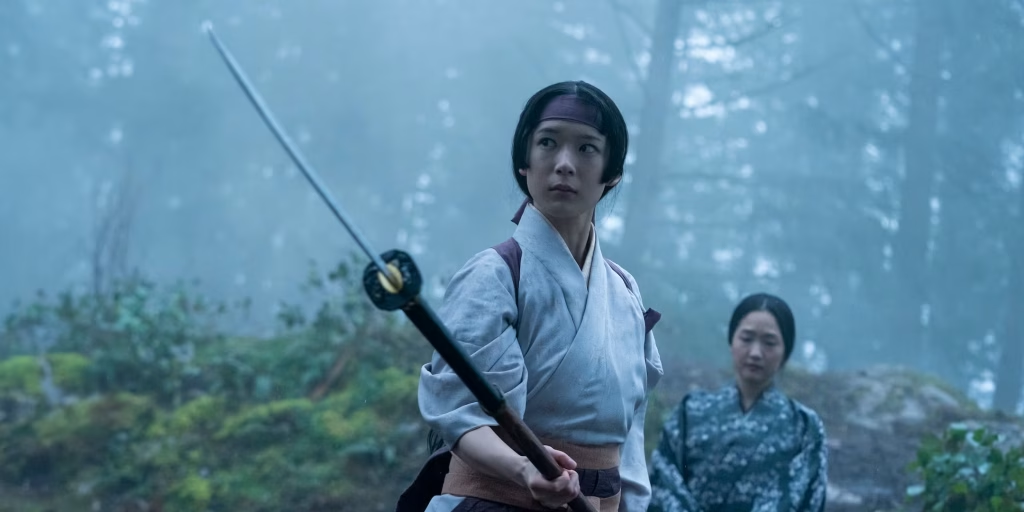
Besides this, there are more fundamental flaws, the most glaring being that in the first half of the book at least, the major female characters, especially Mariko and Fujiko [Fujii] are not given the same depth or force of personality as in the adaptation.
Mariko and Fujii’s first scene in the show, where Mariko talks Fujii out of seppuku as her son is being taken to die with Tadayoshi, is not present in the book, and both their dialogues are trimmed throughout the show or transposed to different scenes that allow the characters to develop more organically independent of Blackthorne’s story.
Mariko’s devotion to the legacy of the Akechi and her desire to serve Toranaga in promoting the peace of the realm emerges much more slowly in the book, and she is openly ashamed of her legacy as an Akechi, whereas “Show Mariko” frames her father’s’ treachery and the death of her family as a tragic martyrdom against a despot from the beginning.

In sum, when Justin Marks, co-creator of FX’s Shogun, spoke of the book as a great work littered with “cultural cobwebs”, he was correct.
More pulp fiction than Greek Drama, more well-intentioned than successful as a depiction of historical Japan, Shogun is not a literary masterpiece, but it remains a highly compelling adventure story that has aged better than expected.
Like The Lord of the Rings: Extended Edition films, it is at times a mixed bag, with about a 1:1 equation of added material that feels essential to 70s cringe that was justifiably cut, yet those who loved the show will likely come away from reading it with an appreciation for the former and an ability to hand-waive the latter.
Stay tuned for the second half of this review in English and the complete Japanese review, both available later this February. In the meantime, check out our Top Picks page, where you can buy the book in print or audio as well as the original 1980 series with Richard Chamberlain, Toshiro Mifune and Yoko Shimada.
The Path/パス is an online bilingual journal of arts, culture, and entertainment bringing you in-depth reviews, news, and analysis on the hottest properties in sci-fi fantasy film, television, and gaming.
Through in-depth research on intellectual properties and major franchises, we develop content covering your favorite books, series, films, games, and shows, such as The Witcher, Cyberpunk 2077, Lord of the Rings, House of the Dragon, Fallout, and Shogun.
If you enjoy our takes, consider buying us a coffee! Your support will help us continue producing excellent pop culture writing in English and Japanese for a true East-meets-West entertainment experience! Arigatō gozaimasu!