


Recently, after having a discussion with Luis about how multiple aspects of Cyberpunk 2077 can be satirized with memes from the “Proud Thug” sketch of Key and Peele, I happened upon the following piece by Luis Gutierrez at GamesRadar (no relation to our guy) commending Jackie Welles as the “best” representation of Mexican Americans he’d encountered in gaming. Punch in “Jackie Welles” and scroll through Reddit for a bit, and Gutierrez seems to express a widely held view among Latino players of Cyberpunk 2077 that Jackie authentically embodies Mexican-American culture in terms of his mannerisms, bilingualism, and values, encompassing everything from his use of Spanglish for emphasis in dialogue to his adherence to traditional values of honor, loyalty, family, and faith. This is exemplified at numerous times throughout the prologue, such as when Jackie dismisses Maelstrom as “these borged-out fuckers” before the Flathead deal, as opposed to the Valentinos (his former gang) “who follow God and the Santa Madre” , or when he crosses himself and recites a Catholic prayer before slotting the biochip during the Heist.

All that being outside my culture, I’ll leave others to discuss Jackie’s role in representation in more detail. What I want to focus on instead is how Jackie’s values and arc in the prologue of 2077 ultimately prefigure the thematic morals of the entire game, which I’ve discussed at greater length here and in my review. Jackie’s character endures because of his human contradictions. While he is jovial, brave, honorable, and self-sacrificing, he’s also stubborn, undiplomatic, and burdened by suppressed resentment. He represents The Fool in much of the same terms as Misty describes V during her Tarot reading during the end stage of the game, and yet a wise one. As the narrative circles back from isolation and despair following the Heist to a vision of community, responsibility, and redemption in the game’s two positive endings (The Sun and The Star), Jackie, in a sense, has the last laugh.


To understand Jackie, you have to begin with a basic portrait of resilience where his positive qualities and ambitions exist side by side with personal traumas they can’t fully erase. From the “Heroes” quest in the game (referenced here in the wiki), we know that Jackie endured an abusive childhood at the hands of his wife-beating father, and from references in dialogue we know that the rest of the “Welles boys” (presumably his brothers or close kin) have been killed in the incessant gang wars of Night City. It’s telling that at the climax of the game, when V has to decided whether and how to assault Arasaka Tower, Misty leads them to the rooftop overlook by specifically invoking an earlier moment of profound stress in Jackie’s life: his decision to sign on, against his mother’s wishes, with the Valentinos. “This is it, chica, I’m done” she recounts him saying, opening a window into a moment of (ultimately overcome) despair that never appears in his character during the prologue until the ride to Konpeki Plaza, where V initially misconstrues his excitement over a “ticket to the major leagues” as being bought-off by Dex. “My whole life I”ve spent in this shit around us, and I ain’t goin’ back” he growls.


While his humor, bravery, and unflappability represent authentic virtues, they’re also, in psychoanalytic speak, “mature defenses” against the justified anger and resentment he feels at being born at the bottom of the totem pole in the dystopian hellscape that is Night City. If Jackie is The Fool obsessed with becoming a Night City legend, he’s also in on the joke. In a world where working class men who don’t attend prestigious prep schools or have elite connections face no chance of climbing the corporate ladder, what else can he aspire to? To be a merc with principles, a hero-for-hire who will kill for coin, represents a way out, however dangerous, of a social structure that would confine him to poverty and mediocrity. At the apex of the merc world comes not just money but fame and status, the glory of being a legend like Adam Smasher or Morgan Blackhand, a man the decadent Corpo class finds indispensable, whether they like it or not.
In many ways, Jackie represents a marked contrast to V, whose goals remain vague and ill-defined at the start of the game. Even if one selects the Corpo lifepath (as I usually do in my repeated playthroughs), V comes across as very unaware of who or what exactly they want to be in this life. Very early-20s energy. It’s no surprise that in his article (mentioned above), Gutierrez uses the Corpo start to contrast the lameness of V’s toast with the typically Latino nature of Jackie’s insistence that “You raise a glass to your mama, your hermana. To the mamacita you’ll meet at the bar,” he says. “But ‘this’ doesn’t say a damn thing.” Even if they begin the story in a position of power and privilege, the game insists, V is still an atomized individual leading an empty existence, subject to the whims of corporate fuckheads like Abernathy and Jenkins who will trade their life away on a whim. In this start, Jackie’s intervention both literally and spiritually saves V’s life by scaring off Abernathy’s hit squad and freeing them from a meaningless assent up the corporate ladder. While Jackie wants to be in “the major leagues”, he wants it on his terms, not to simply assimilate to corporate values.
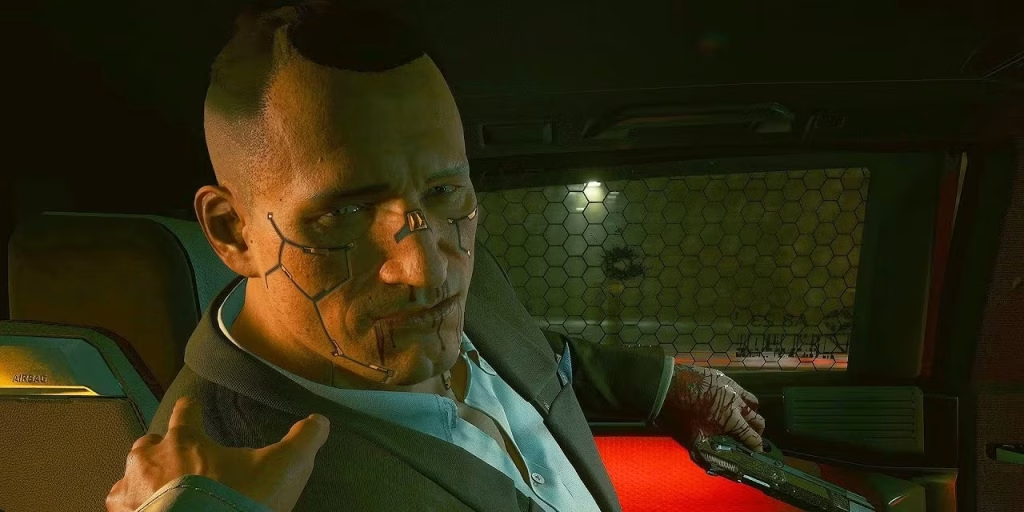
As I’ve argued many times in the past, Cyberpunk 2077‘s primary concern is V’s journey from The Fool who chases empty dreams and gets others killed to the Legend who would rather die, gun in hand and on fire, rather than drag their friends down with them. The hero who would rather send Songbird to the Moon despite massive personal betrayal rather than sell her into slavery to the corrupt NUS as a superweapon. While Jackie’s death, as much as V’s own near-death, is the foundational trauma of Cyberpunk 2077, eventually V’s personal growth is dependent on becoming more like Jackie: a man or woman of honor who, while violent, puts the needs of others before their own, fights for their friends like Judy and Panam, and never gives up. So raise a glass to the Choom of Chooms, one of the best supporting characters in 2077, gone too soon. Descanse en paz leyenda.
Photo Credits PC Gamer, GameRant, Cyberpunk Wiki, meme photos captioned and edited by the Path
The Path/パス is an online bilingual journal of arts, culture, and entertainment bringing you in-depth reviews, news, and analysis on the hottest properties in sci-fi fantasy film, television, and gaming.
Through in-depth research on intellectual properties and major franchises, we develop content covering your favorite books, series, films, games, and shows, such as The Witcher, Cyberpunk 2077, Lord of the Rings, House of the Dragon, Fallout, and Shogun.
If you enjoy our takes, consider buying us a coffee! Your support will help us continue producing excellent pop culture writing in English and Japanese for a true East-meets-West entertainment experience! Arigatō gozaimasu!