

In Ptolemaic cosmology, the geocentric system of astronomy and physics that held sway in the West from ancient Greece until the 17th century, the universe was divided into spheres. Beneath the sublunar sphere where the elements of earth, air, water, and fire dominated, all was subject to mutability and change. Beyond the moon were the spheres of aether, the unchanging, immortal substance that composed the planets and the stars, and farther still, beyond the outer bounds of the universe, lay the Unmoved Mover, by turns Zeus or, in later religions, the Abrahamic God. All beneath the moon was corruptible. All above it, incorruptible. It is for this reason that, in praising the verisimilitude of his art to real life, Samuel Johnson could say of Shakespeare that his work “[exhibited] the real state of sublunary nature, which partakes of good and evil, joy and sorrow, intermingled”. For this same reason, in order to praise his love for his wife as transcending mere sensuality, John Donne contrasted it in “A Valediction: Forbidding Mourning” with “Dull sublunary lovers’ love / (Whose soul is sense)” that “cannot admit / Absence”. It goes without saying that as the realm of change, the sublunary sphere was also the realm of death, where the soul “fastened to a dying animal” ultimately shed it’s corpse and drifted upward (or downard) to its eternal reward or damnation.
For players and watchers of Cyberpunk 2077, the moon is a core piece of iconography. It is where you send Songbird in arguably the best ending to Phantom Liberty, itself gesturing back to David’s rescue of Lucy in the Edgerunners anime. The moon is escape, fulfillment, freedom, life—the realm of the spiritual in a spiritually dead universe, where both religion and any secular system of ethics has withered away in the face of the profit motive, the will to power, and the untroubled logic of kill-or-be-killed. We often think of atheism and religion in both spiritual and political terms as polar opposites, but this is deceptive. Ultimately, both partake of the universal human desire for truth, and both can succor or inculcate despair. In religion’s case, this is monasticism—the irrational choice to be dead to the world. In atheism’s case, it is nihilism—the inane pursuit of pleasure and power at all costs, not for the sake of joy, but out of the narcissistic desire to avoid the finality of death which atheism forces us to confront without fairy tales.
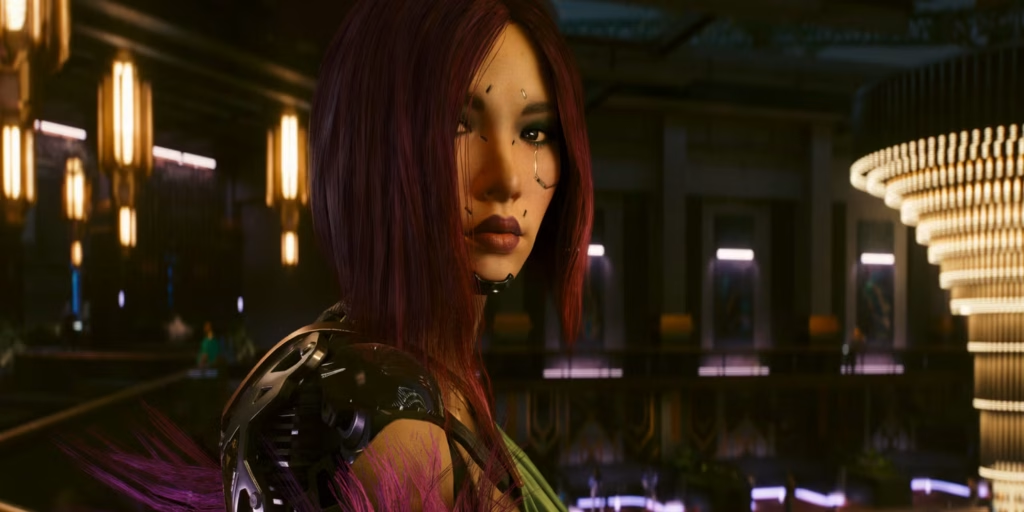
When Joshua Stephenson asks to be nailed to a cross in the “Sinnerman” sidequest and requests for you to pray with him before his execution, the player can substitute the Jewish Amidah prayer or a reading from the Rig Veda for the Lord’s prayer out of Christianity. I never particularly understood this decision on the part of the developers, but perhaps it gestures at the sheer absurdity of a pseudo-martyr committing suicide in the name of Christ in a godless universe. Likewise, in the “Devil” ending to the base game, when Saburo Arasaka is resurrected after his engram overwrites the identity of his traitorous son, we’re told by a news report that several hundred philosophers and religious leaders have signed an open letter condemning the “Emperor’s” cheating death, an act sure to sway the decision making of whatever valiant government regulators or activist ESG shareholders exist in this fallen universe. Fittingly, the “Devil” ending to Cyberpunk 2077 also occurs on the moon, where V undergoes a kafkaesque round of scientific testing after surgery only to learn in the end that their condition is incurable and their betrayal of their friends has been for nothing. Where others find salvation on the moon, in this ending at least, V finds damnation. Their damnation is not, as far as we can tell, consignment to the flames, but rather return to the world of changes in the knowledge that they have no legacy and their life means nothing. They will die alone, deprived of meaning in this life and hope in the next.

If death, as Wallace Stevens wrote, is “the mother of beauty”, the hard finality that gives meaning to time and experience in a godless universe, then some deaths in Cyberpunk 2077 must be called beautiful. First among these is David’s death in Edgerunners, which is presented unequivocally as a moral victory despite our hero getting his head blown off by a rocket. He has saved Lucy after failing to save so many others, and so he dies content in the knowledge that his love will survive. He has no regrets. At the opposite end of the spectrum is Gloria Martinez’s death, which is both senseless, random, and possibly preventable, given that Edgerunners implies it’s as much the contempt and indifference of Night City’s health professionals that kills her as the Animals gang’s mayhem. One need not have followed the murder of UnitedHealthCare CEO Brian Thompson with much interest recently to grasp that Americans justifiably resent and hate their health insurance system and those who profit from it. Is Luigi Mangione, minus the neural implants, so different from the characters we celebrate in Cyberpunk, who are, in all honesty, mostly stylish outlaws and murderers?
Leaving that question aside, immerse yourself long enough in Cyberpunk 2077 and you quickly come to realize that death and dying are the connective threads that hold the entire game-universe together. 2077 has been called nostalgic or uninnovative at times in its approach to the cyberpunk genre, but that misses the point. While earlier franchises like Gibson’s Neuromancer trilogy or “Ghost in the Shell” were genuinely fascinated with technological advancement and the implications on a civilizational level of the internet and AI, Cyberpunk 2077 is not concerned with “how this all works” nor the contemporary political moment. Nuanced discussion of issues like race, gender, democracy versus authoritarianism, and even the impacts of social media are notably absent. In part this likely represents the reality that in order to make money and appeal to the widest possible audience, a triple A studio has nothing to gain from wading into the culture wars, whether American or Polish, and inevitably tarnishing its brand by being labeled left wing or right wing. But it also likely reflects a certain indifference to the minutia of technological advancement and current affairs.

As Luis has demonstrated again and again in his articles on Johnny Silverhand and Night City, Cyberpunk isn’t interested in what changes when we have cell phones imbedded in our skulls or retractable saws in our forearms, but what stays the same. What happens to the human element in a techno dystopia in which both individual and collective security have broken down? What is life without meaningful relationships? Who are we but our memories? What makes a human consciousness or mind “alive”? What matters in a universe without a god or immortal soul? V wants to be a “legend” in Night City, a status that, as per Claire in the Afterlife, is attainable only in death. Will we revert, in the future, to some sort of pagan pursuit and worship of an immortal name as our highest goal in life, or were all other conceptions of immortality vain to begin with? Regardless, death is the mother of beauty in Cyberpunk 2077, the key to understanding everything. To those who would allege 2077 is mere cheap entertainment and says nothing of thematic value, I would counter that this is obviously false. Cyberpunk 2077 says at least one thing very clearly: memento mori. Remember death.
Image credits GameRant, Studio Trigger, and CD Projekt Red
The Path/パス is an online bilingual journal of arts, culture, and entertainment bringing you in-depth reviews, news, and analysis on the hottest properties in sci-fi fantasy film, television, and gaming.
Through in-depth research on intellectual properties and major franchises, we develop content covering your favorite books, series, films, games, and shows, such as The Witcher, Cyberpunk 2077, Lord of the Rings, House of the Dragon, Fallout, and Shogun.
If you enjoy our takes, consider buying us a coffee! Your support will help us continue producing excellent pop culture writing in English and Japanese for a true East-meets-West entertainment experience! Arigatō gozaimasu!