

As a new track is released from The Lord of the Rings: The War of Rohirrim soundtrack, let’s review why making anything good in Middle Earth is so damn hard.
Heo Is Se Wind
While we still have no idea if Nausicca of the Valley of the Rings…excuse me, The Lord of the Rings: The War of the Rohirrim…will be any good, we now have some very Florence+The Machine-sounding theme music for the new flick courtesy of some “rising artist” ( read: obscure singer) named Paris Paloma, a very cottage-core looking, seemingly British Gen Z woman who can be seen wearing an Evenstar necklace in this video. Cool? To be honest, I found the music forgettable, but the inclusion of a line of Old English in this song was a nice touch (Ultra-Nerds may recall that in The Lord of the Rings: The Two Towers Extended Edition, Eowyn can be seen keening for her cousin Theodred in Old English during the funeral scene).
Here at The Path we’ve had a steady drip of Rohirrim content of late, including Olivia’s trailer analysis and my take on how optimistic (or not) we should be about this film. In the end, while we now know for example that Saruman (Christopher Lee) has not been resurrected through A.I., there’s little to say of substance at present. I find this film has been bafflingly under-marketed, which bodes ill, considering one would think that if Warner Bros. wanted or needed to make a bunch of money with Rohirrim, they would’ve been hyping it relentlessly, especially when the fanbase is hungry for something set in Middle Earth that is actually good, instead of, you know, mousy Galadriel and racist Not-Hobbits.

All Harfoot photos have been removed in accordance with our D.E.I. policies, specifically our core commitment “don’t antagonize the Irish”.
What I’m not seeing is a sense of urgency or what use to be called “water-cooler talk” around this movie. Zero. Which means in the end that unless War of the Rohirrim comes from behind to prove an exceptional hit, it’s likely, looking back six months from now, that we’ll all agree this movie came and went. While animated versions of The Lord of the Rings were made prior to the 2000s, these are little remembered and mostly unloved. Any post-2003 adaptation of Tolkien’s works must also contend with the basic fact that a reinvigorated Middle Earth in 2024 requires a significant degree of both discipline and invention to make anything new in.

On Lore
It isn’t enough merely to have read The Lord of the Rings, The Hobbit, or The Silmarillion. Whereas most fantasy loreists seemingly conflate two or three historical epochs and then scribble out a genealogy and a few gobbledygook words in Dothraki on a napkin to build their universes, Tolkien was a professional scholar whose works have sustained deep literary analysis across a variety of disciplines for the past seventy years. His Elven languages (Quenya and Sindarin) were actually speakable prior to filming, and his elaborate backstory for the world of Middle Earth was a rich adaptation of Northern European myth and Judeo-Christian (particularly Catholic) theology spanning millennia.
The greatest barrier to making new works of an excellent character in Arda is that the lore (and we call it “lore” because that is what Tolkien’s characters call it in The Lord of the Rings) is truly lore in the way religious scriptural exegesis is: a self-contained and systematic body of historical and moral knowledge that has to be mastered before anyone can say anything new or original of value within it. Tolkien’s “lore” is both the history of Middle-Earth and the moral and intellectual principles deriving from it.
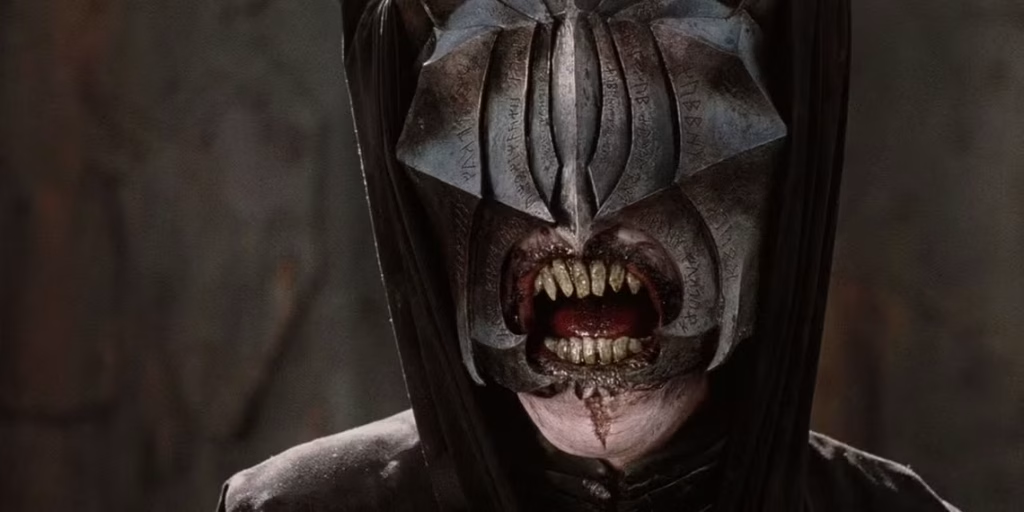
To make a good adventure tale within this universe, one of course has to be entertaining, but bend the lore too far from the letter or spirit of what Tolkien actually wrote, and false notes creep in. This was true even of the original film trilogy. At their best, the films condensed and trimmed the book into an operatic masterpiece. At their worst, by which I mean about half the added material in the Extended Editions, they sagged under the weight of scenes like the killing of Saruman and the Mouth of Sauron that looked cool but ultimately contradicted the characterizations of Gandalf, Aragon, and the moral logic of the book itself.
We Don’t Use The Word “Fun”
A final problem confronting any adaptation of Tolkien in this day and age is that Tolkien only produced one true masterpiece of narrative prose fiction in his lifetime, The Lord of the Rings, and that work has been filmed. The modern creator seeking to build in Tolkien’s universe thus faces inherent disadvantages.
She must say something new that is in conformity with the basic logic and spirit of Tolkien’s work, even if that requires a need to challenge or expand the values of Middle Earth to a degree, as the the film trilogy did with Eowyn to considerable success (a subject for a later article). She must be able to understand the complexities of what she’s working with on an academic level to establish a coherent idea of what the spirit and logic of Middle Earth actually are.
And she must avoid the pull of “Chrisotpherianism”, (a term I made up just now), the mistaken belief, espoused most fervently by Tolkien’s executor and son, that the films had “gutted the book” by “turning it into an adventure story for fifteen to twenty-five year olds” and that the intellectual rigor inherent in the work required it to move at a pace sufficiently didactic and boring to dissuade stupid people. This attitude, which one tends to encounter on the internet from time to time, is itself rather blinkered and underserving of further comment (And so naturally, it may form the subject for a later article). When all’s said and done though, some of those random drinking, walking, and bathing songs from the book are just quite bad. Every adaptation requires some cuts. But, as far as The War of the Rohirrim is concerned, in conclusion…

Conclusion
Just don’t fuck this up.
All photos property of Warner Bros.
As an Amazon Associate I earn from qualifying purchases
War of the Rohirrim already has merch, including concept art#ad and coloring books!#ad Buy, you fools!
The Path/パス is an online bilingual journal of arts, culture, and entertainment bringing you in-depth reviews, news, and analysis on the hottest properties in sci-fi fantasy film, television, and gaming.
Through in-depth research on intellectual properties and major franchises, we develop content covering your favorite books, series, films, games, and shows, such as The Witcher, Cyberpunk 2077, Lord of the Rings, House of the Dragon, Fallout, and Shogun.
If you enjoy our takes, consider buying us a coffee! Your support will help us continue producing excellent pop culture writing in English and Japanese for a true East-meets-West entertainment experience! Arigatō gozaimasu!