
As an Amazon associate I earn from qualifying purchases
I’ll confess, I never finished Season of Storms. Whatever his motivation for releasing a spin-off adventure for Geralt of Rivia (set just before his fateful trip to Temeria in The Last Wish) Andrzej Sapkowski’s “sidequel” to the seven volume Witcher saga was thin and inessential, a lesser plot with lesser writing that served to remind readers of Sapkowski’s worst tendencies during his banner decade in the 1990s without rekindling any of the magic that made novels like The Swallow’s Tower and The Lady of the Lake classics of pulp fiction.
As we eagerly await the eventual release of The Witcher 4 and The Witcher Remastered from CD Project Red, it’s apparent that this multimedia franchise specializing in all things Wiedzmin is in desperate need of quality control. As a cultural phenomenon, The Witcher undeniably peaked in 2019 with the release of its Netflix adaptation’s first season. This season was, in hindsight, deeply mediocre and overpraised relative to its actual merits, but it drove millions of fans to play CD Project Red’s Witcher game trilogy#ad and delve into Sapkwoski’s prose, the first volume of which, The Last Wish#ad, famously was reprinted in half a million additional copies after selling out in 2020 and shot up to the New York Times Bestseller List off the strength of season 1.
On The Decline and Fall of the Witcher Empire
The subsequent half decade of The Witcher, concurrent with the lifetime of The Path (which was initially set-up in October 2019 as a Witcher fan site in anticipation of season 1), has been one of managed decline. While The Path has grown exponentially over the past year in terms of the reach, output, and quality of our articles, this has coincided with a belated but decisive shift on our part from a Witcher-centric lens to focusing on bilingual content in the broader genre of sci-fi/fantasy, as well as works like Shogun that do not strictly fit into said genre but share some overlapping principles. Meanwhile, The Witcher has imploded.
After a disastrous second season that veered so far from the books as to betray the showrunners’ utter contempt for their source material (a popular fan allegation reinforced by disgraced former Witcher writer Beau DeMayo, who, despite his allegedly abusive personality, seems on par in this instance), The Witcher has gone from bad to worse. With the atrocious Blood Origin prequel, which somehow totally wasted the excellent Michelle Yeoh, The Witcher doubled down on every aspect of its worst tendencies. Incoherent writing. Bad VFX. Insufferable, unsubtly political dialogue that could’ve been written by Alexandria Ocasio-Cortez. Terrible musical numbers.
Goodbye, Geralt
Basically, by the time season three rolled around, with Henry Cavil reduced to about 25 minutes of screen time despite playing the title character in a show called The Witcher, I was done, as were a lot of people. In Season 4, I fully expect to see Ciri riding around in a keffiyeh yelling “Free Palestine” as the Rats attack merchant caravans with orange Hamas triangles painted on them (“fictionalize the intifada!”), at which point Leo Bonhart will fly by in a Koviri warplane out of nowhere and bomb Mistle and company to Hell. Thanks, Leo.
So why precisely is Andrzej Sapkowski releasing yet another Witcher novel in December, with an international release likely early next year. Fuck if I know. There is no reason to do this. Sapkowski is clearly satisfied with his conclusion to the original saga, and has resisted all demands to continue it for a quarter of a century. Despite repeated speculations and calls for a “Ciri saga” in the books or CD Projekt’s games, Sapkowski has shown no interest in developing Ciri’s narrative beyond The Lady of the Lake‘s conclusion, and CD Project’s Witcher 4 plans remain cagey (as they should following the wild over-promising of Cyberpunk 2077, which did justify the hype…about 3 and a half years after it exploded on impact).
Hang Up Your Swords
As a writer, I get it. As a craft and as a way of life, no serious artist ever wants to give up his trade, and writing is fortunately one of the few you can do up to the day you die. But as the downfall of the Marvel Cinematic Universe should have attested by now, every good story has an end, and there is a limit to how much content you can wring, even as its author, out of good Intellectual Property. Tolkien seems to have toyed with but wisely never written a sequel to Lord of the Rings in his old age. His 21st century adapters (Peter Jackson, along with primary screenwriters Fran Walsh and Philip Boyens) have never surpassed their achievement in the original trilogy, and despite my hopes for War of the Rohirrim, their successors have been even less successful. At some point, to paraphrase Donald Glover, being the king means knowing when your reign has ended.
When Aragorn sensed the onset of extreme old age in the appendices of The Lord of the Rings, he chose to willingly relinquish his life rather than linger on dotardly and unmanned till death. Alas, as mortals, we do not always have the Gift of Men that allowed the race of Numenor to die at their chosen time with dignity. But the things we build, like us, are finite, and at some point, we must move on from them and depart. Geralt’s race is run. Let other stories be told.
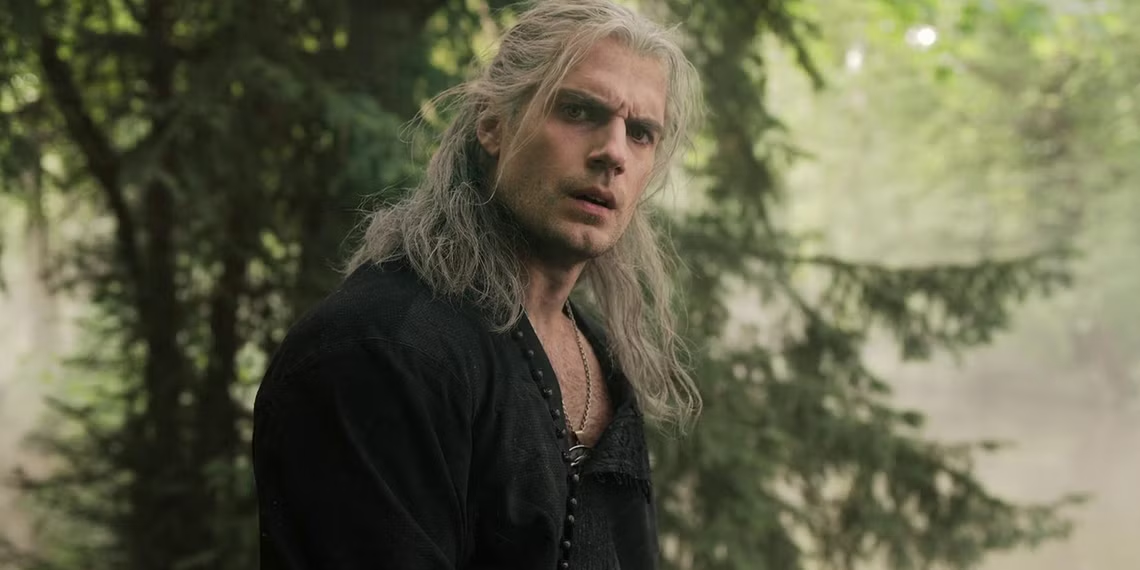
Photo property of Netflix
Benjamin Rose is the Editor and owner of The Path
The Path/パス is an online bilingual journal of arts, culture, and entertainment bringing you in-depth reviews, news, and analysis on the hottest properties in sci-fi fantasy film, television, and gaming.
Through in-depth research on intellectual properties and major franchises, we develop content covering your favorite books, series, films, games, and shows, such as The Witcher, Cyberpunk 2077, Lord of the Rings, House of the Dragon, Fallout, and Shogun.
If you enjoy our takes, consider buying us a coffee! Your support will help us continue producing excellent pop culture writing in English and Japanese for a true East-meets-West entertainment experience! Arigatō gozaimasu!