
Episode 1-3 Review
As an Amazon Associate I earn from qualifying purchases
Score: 2/10
What do we owe The Rings of Power? As a lifelong Tolkien fan for whom the novel#ad and the original film trilogy (including Howard Shore’s magnificent score) occupy a place analogous to a religious text, it would be tempting to answer “nothing”. From its start, the show has been a dubious affair, famously dismissed by the late, great Bernard Hill (Hail, Théoden King!) as “a money making venture” he never bothered to watch. Any good will towards the cast and crew in the face of a gross racist onslaught before season one cannot excuse the fact that while their efforts were genuine and their right to be represented in Middle-Earth absolute, representation is hollow when it becomes a divvying up of the spoils of mediocrity. Amazon was not wrong to cast people of color in Lord of the Rings: The Rings of Rower. It was wrong to ever make it. As the series returns for season 2, all the strengths and weaknesses of the initial season (famously pilloried as “2/10” by Luis, scored more generously by me as “5.5/10”) remain.
This show is the most visually lavish thing on television, having traded the rural beauty of England and Wales for the more familiar wildness of New Zealand, but amid that splendor, what one publication rightly described in season 1 as the money “bleed[ing] right through the screen” The Rings of Power is empty. Like a Nazgûl gliding through the unseen world, neither living nor dead, the show is a vapid, diminished depiction of Tolkien’s Middle-Earth, sans humor, sans heart, sans character, sans everything. Gondor may not yet exist in the Second Age, but it’s clear that long before the first stone has been laid in the seven levels of Minas Tirith, the rule of Middle-Earth has passed to lesser men. The age of quality is over. The time of mediocrity has come. There will be no dawn for ROP.

Season 2 has a few basic through-lines. With Halbrand now revealed to Galadriel and the elves of Eregion as Sauron, much drama ensues over how and how seriously to counter Sauron’s threat. He is, says Gil-galad, “without army or ally” as opposed to the very real menace of the first orc, Adar, in Mordor. As Sauron infiltrates Mordor in human form to pledge his service to Adar and manipulate him to his will, Galadriel and Elrond bicker circularly about the safety of using the Three Rings of Power and whether or not they contain Sauron’s influence.
Soon things come to a head with two major developments in these first three episodes: a massive earthquake damages the infrastructure of Khazad-dûm, imperiling its future, and Sauron appears to Lord Celebrimbor, the forger of the rings, as “Annatar”, the Lord of Gifts, an angelic emissary of the Valar (Essentially, the lesser gods of Arda, who rule the Tolkienverse#ad at the will of Eru Iluvatar, the Judeo-Christian God) promising a solution. With Annatar’s guidance, Celebrimbor will forge rings for the Dwarves and, more controversially, Men, to check Sauron’s corruptive influence over the natural world of Middle-Earth and oppose his evil. Except, you know…

Credit must be given to Charlie Vickers and Charles Edwards. At times it seems they’re the only ones actually acting in this show, and certainly all scenes where one or both of them aren’t present fall limp. Morfydd Clark and Robert Aramayo as Galadriel and Elrond are forgettable for somewhat the same reason a much better actress, The Witcher‘s Anya Chalotra, has been repeatedly shortchanged in that show. It is dangerous to cast eternally youthful characters many decades or centuries old with actors in their twenties, because, speaking not as an actor but as a 29 year-old, most twenty-somethings simply lack the gravitas or world-weariness to pull it off. Clark and Aramayo are are in their mid and early thirties respectively, and they still seem lamentably university-aged compared to Fellowship of the Ring-era Cate Blanchette, who was younger than both at the time, or to Chalotra, a fierce talent saddled with the albatross of idiotic writing.

These two, essentially the major Elf leads for the show, have been given bland writing, but by no means idiotic, to their discredit—like Benjamin Walker’s Gil-galad, lines that would be powerfully sententious or otherworldly in the mouths of actor’s of greater conviction become banal. There are, and have always been, two many pretty, insubstantial cast members on this show of each gender and race who feel “telegenic” in a way Viggo Mortensen, Bernard Hill, John Rhys-Davies, or Sean Bean never had to be, and in a way Blanchette, Miranda Otto, or Liv Tyler never relied upon.
Mortensen in particular, then already a middle-aged dad (daddy?) was widely considered the most desirable man in the world for a time, and often still is by female fans and nostalgists like Margot Robbie. The films never indulged this—Aragorn’s sex appeal was always rooted in the mix of rugged masculinity, tenderness, and quiet, unyielding sense of honor and competence that drove his character. He was the thinking man’s action hero and a natural leader of men—women fell for him, and men died for him. To compare him to Maxim Baldry’s doe-eyed, often bumbling and useless Isildur is embarrassing, even when one considers that Isildur as a character was already the ultimate failson. Even Nagakado from Shogun accomplished more.

Likewise, Tyler’s Arwen was proud, ethereal, and tragic in a way that leant the utmost credence to her romance with Aragorn (largely taken and expanded from the book’s appendices) despite the actors’ 19 year age difference (she was only 22 at the start of filming). She is neither helpless damsel nor warrior princess, and yet possessed of a strength and maturity that no amount of corporate welfare money (excuse me, Amazon cloud-computing services to the U.S Government) can buy.
Onscreen, they felt like an actual couple—one that has loved for decades, for whom every moment is together charged with meaning. Tyler, Like Miranda Otto’s fierce, frustrated, unrequited, but triumphant Éowyn, is breathtaking—because like women out of literary fiction or actual friends or lovers they feel alive, with a beauty that is embodied beyond looks in word, action, and thought. By contrast, I can’t recall a substantial sense of vitality from almost any of the major cast of Rings of Power—you would not love them, fight with them, drink with them, or die for them if you knew them for a decade. They are a rotating cast of chastely clad himbos and bimbos. Even those racist little hobbit-esque things suck. Did Louis C.K. invent them?

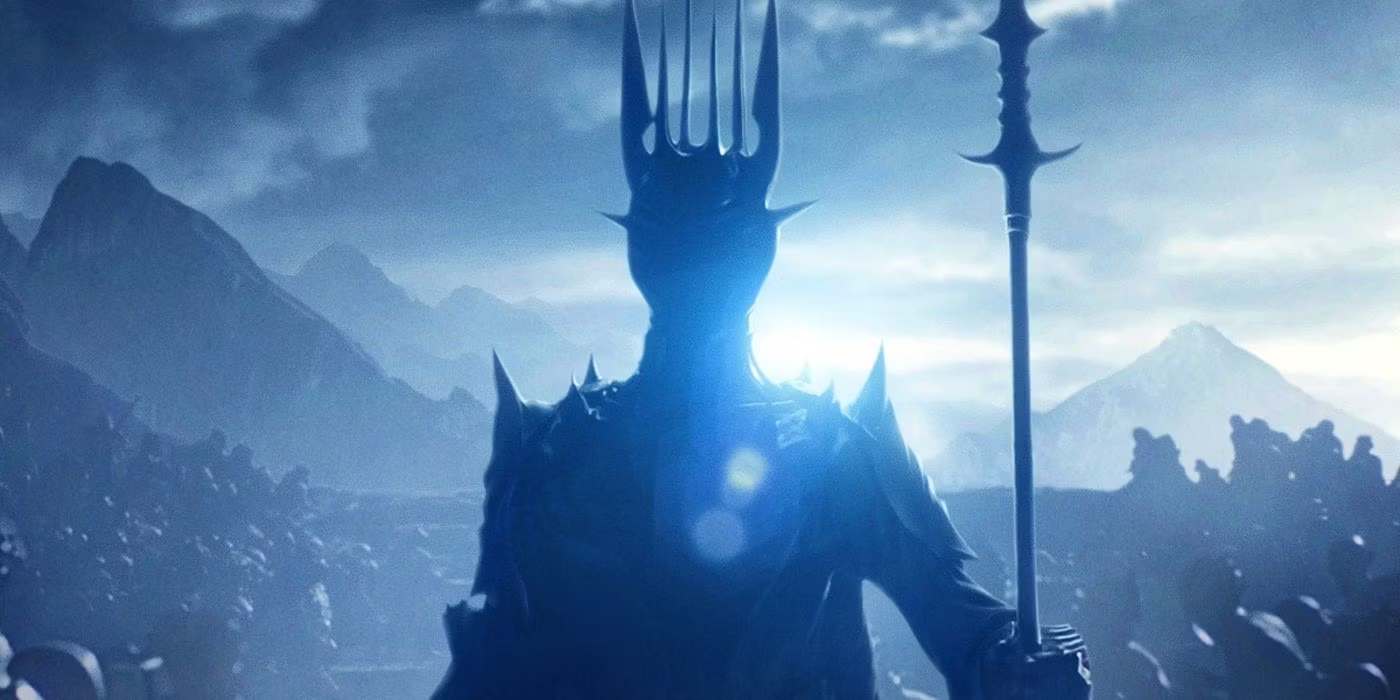
But then there’s Sauron. Vickers (besides Edwards’ Celebrimbor) is the only one who looks like he’s having any fun at this, and he manages Sauron’s feats of manipulation, violence, and survival in these opening episodes with an understated glee, having finally been able to let his hair down, so to speak, after season one’s “Where’s Waldo the corrupted Maiar?” slog. Tolkien’s Sauron was Evil Incarnate, his very absence, like the monster in a good horror flick, serving to increase his dread, a Nameless Fear who slithered into the minds of all who faced him, his very gaze when revealed as the Eye an agony and a terror to behold to Man, Wizard, and Hobbit alike. So far Rings of Power has done something entirely different, presenting Sauron not as the Shadow itself but the banality of evil—a fallen angel who, like Milton’s Satan, is both mighty, charismatic, and, we can’t help but notice, a pathetic narcissist rather than a one-note sociopath. This is not a mistake.

The showrunners’ most daring decision so far has been to start Sauron at the bottom of the power curve and create at least a hint of ambiguity that he occasionally feels remorse. They should’ve gone farther, and do so while they still have time. Tolkien says Sauron only repented in the second age out of fear, while Milton’s Satan, or Shakespeare’s Iago—both cited multiple times as inspiration for the show’s Sauron by Vickers and the showrunners—both present fascinating models for what that might have looked like in practice (as does Tolkien’s own Saruman, for that matter, who gets off much lighter at first than Christopher Lee’s in the films, and precedes to dig his own grave all the deeper before that fatal stab in the back).
There is a strong case to be made based on the Annatar/Celebrimbor scenes that I’ve seen so far that we’re not merely watching a bad series—we’re watching the wrong one. This is Sauron’s show, and the more it can lead into the innate drama of his first defeat—the right hand of evil, brought low, setting himself up as a god only to be felled by some lame dude in eyeliner from an early 2000s pop punk band—the better. The tragedy of Sauron is that having been corrupted by Morgoth, he wastes millennia trying to emulate his master for diminishing returns, a sort of Trump to Morgoth’s Roy Cohn. And in the end, after all that hatred and darkness, nothing remains but a shadow blown away, wailing on the wind as the federal charges are handed down. Give us that show, better actors, and better scripts, please.

For as anyone whose read some of the secondary material in the legendarium knows, it was Sauron who defeated Sauron in the end where all Free Peoples couldn’t—nor human act, nor direct divine intervention, save in the cosmological fact of Tolkienverse that while Good can make out of nothing (creatio ex nihilo), Evil can only mock and degrade what is made by others until, in the end measuring all things by itself blindly, it warps inward and is consumed. Just like this show.
As any deeply versed LotR-head knows, Gollum swore on the Ring not to harm Frodo—and the Ring, bound by its own vindictive nature to hold him to his word, killed him along with its master and itself the second Gollum recovered it. Without delving too deeply into Tolkien’s Catholic philosophy (my Aquinas is rusty) or seeking to turn a show review into theology—one could make an almost deist argument for Eru’s Providence in this outcome. Without putting his thumb on the scale, the All-Father left his creations “sufficient to stand but free to fall”—and down they went in accordance with his plan, not because he chose for them, but because they didn’t read the rule book.
These are the sort of grand architectonics that make LotR a truly literary work worthy of such coinages as “mythopoeia” (literally “myth-making”) and “eucatastrophe” (“Good/fortunate disaster”). That was Tolkien’s’ genius—to distill deeply serious and complex meditations on ethics, language, history, religion, politics, and power into a rousing, though often deeply elegiac, action adventure with vividly realized characters. Jackson’s achievement was to film it, pruning the intellectual depth of the work as needed to make it more accessible to mainstream audiences, while retaining enough of the emotional core and intricacy of the plot to make the world’s greatest fantasy novel a blockbuster and an opera.

Even if The Rings of Power was made in earnest—does it matter? A man may write terrible poetry to his wife, another immortal verse to a girl he caught feelings for after a bad hookup—but the feeling is in the art, the thing made, not the maker. In true craftsmanship, earnestness will out—in bullshit, it becomes pathetic.
The Rings of Power was a failure in season 1, and by all appearances is so again, because it was unoriginal and boring. You gaze into its eyes and feel nothing but the abyss. I would rather watch Frodo and Sam go on a hiking date for the entire first 45 minutes of The Fellowship of the Ring: Extended Edition (that’s literally the plot) than watch the entirety of whatever insipid questline this series has to offer over the next decade. Unlike Arwen, I did not choose a mortal life—but I would rather spend one life with The Lord of the Rings novel and film trilogy than face all the ages of this world alone with nothing but The Rings of Power to keep me company.
All photos are property of Amazon and New Line Cinema except the photo of the show runners, which is owned by Jeff Spicer via Esquire.
The Path/パス is an online bilingual journal of arts, culture, and entertainment bringing you in-depth reviews, news, and analysis on the hottest properties in sci-fi fantasy film, television, and gaming.
Through in-depth research on intellectual properties and major franchises, we develop content covering your favorite books, series, films, games, and shows, such as The Witcher, Cyberpunk 2077, Lord of the Rings, House of the Dragon, Fallout, and Shogun.
If you enjoy our takes, consider buying us a coffee! Your support will help us continue producing excellent pop culture writing in English and Japanese for a true East-meets-West entertainment experience! Arigatō gozaimasu!