

Peak Human Buntaro
Episode 3. As Toranaga, his retainers, and Blackthorne escape from Osaka harbor by rowboat, they sight Buntaro, still alive after remaining behind in the forest to delay Kiyama’s men.
He arrives moments too late to join them. Shooting one enemy with his bow before single-handedly cutting down six or seven men armed with katana and naginata, Buntaro casts one last longing look at Mariko before being hailed by his lord and rushing up the docs to meet his death. Though he survives, with Toranaga proclaiming him a “miracle” for having fought his way to Edo in the company of twenty ronin, all of whom but one died, by episode 5, Shogun is exceptional as a medieval (or medieval-adjacent) saga for how rarely it indulges in these flights of martial fantasy.
Usually, as in shows like HBO’s House of the Dragon, overpowered protagonists and major characters are the norm. In episode 3 of HotD, when Daemon Targaryen surrenders during the war in the Stepstones in a bid to draw out and assassinate the Crabfeeder, he manages to single-handedly kill 16 men while being fired on by hundreds of archers, and survives after being shot thrice. While he doesn’t single-handedly win the battle, and has been already established as an exceptional warrior, this scene strains the limits of credulity, though perhaps no more than Boromir killing 20 orcs in The Lord of the Rings, almost single-handedly, before he is eventually shot down and killed.1

Armor and Accuracy
“The mightiest man may be slain by a single arrow, and Boromir was pierced by many” as Pippin puts it in The Return of the King.
Yet even as it accords Buntaro a rare superhumanesque level of prowess, Shogun implicitly balances this creative decision by reference to certain real world advantages and limitations Buntaro possesses. First and foremost, he is armored, and in Shogun, as I once put it, armor works. While he can freely slice and dice his way through most of his opponents, they are forced to attack weak areas for their weapons to have any real effect. Second, while Buntaro is highly skilled, he is not shown flipping through the air or engaging in other wire-assisted bullshit, as in this fight in The Witcher, for example.
Violence in Shogun is unspectacular, which is not the same as to call it boring. While on a few occasions, notably that gutfest of a chain-shot massacre in episode 4, it can be every bit as shocking as any episode set in the A Song of Ice and Fire#ad universe, Shogun employs violence sparingly and grounds its most appealing expression, combat, through the same lens of strict realism the show brings to its depictions of historical Japanese and European politics and culture.
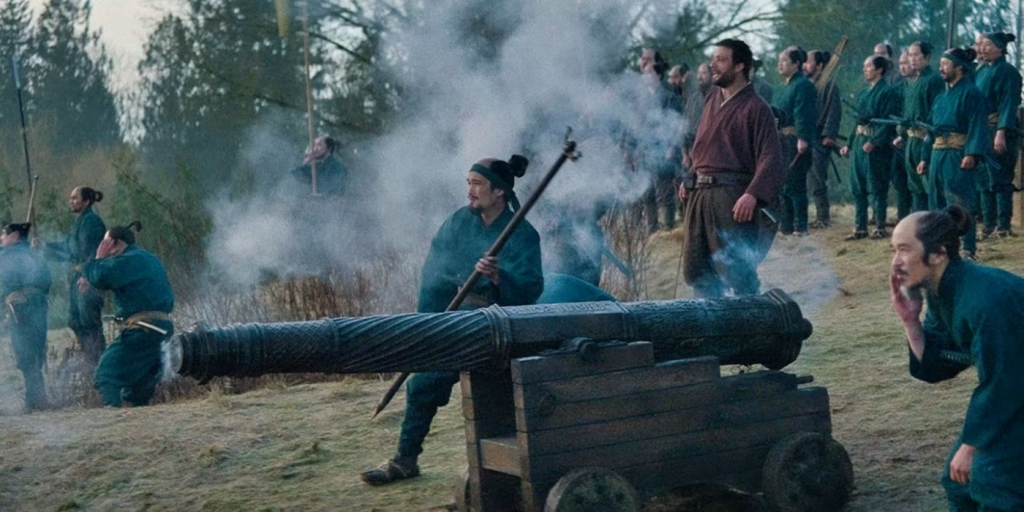
When horses and men explode in an orgy of blood, that is modeled on the real-world effects of artillery weapons. When the samurai leading Mariko’s escort is killed in episode 9 by a bowshot, the arrow hits him in the neck where, as with the knee and shoulder joints, armor was historically weakest to accommodate movement.
This fact is alluded to in passing in Peter Jackson’s The Two Towers just before the Battle of Helm’s Deep, when Legolas instructs the archers of Lórien that the Uruk-hai’s armor is “weak at the neck and under the arm” though the actual battle largely ignores this principle. Shogun has other ideas.
This “no bullshit” approach to combat is described in some detail by stunt coordinator Lauro Chartrand Del Valle in Episode 3 of Shogun’s Official Podcast, and the principles he lays out are strikingly opposed to the contemporary standards of American prestige TV and Hollywood action cinema.
“A lot of it [historical combat] was over quickly…you get cut with one of those swords or that naginata, you’re done…One of the biggest things that I fought for is [that] you’ll see in a lot of fight scenes today, especially when it comes to sword work or any weapon work, that the stunt guys, they’ll clack their swords over their head, this guy’ll attack and that guy didn’t even need to block because he’s swinging too high. So, if you’re attacking somebody, you gotta attack for the target, and that’s even more important when they’re wearing armor, because there’s only two or three points where you can get through that armor. So its gotta be for the neck and its gotta be under the armpit, its gotta be the back of the knee, places like that. And so if they weren’t hitting it, I’d call bullshit…“
Lauro Chartrand–DelValle

Beyond “Bullshit”
With Hollywood “bullshit” excluded, however, Shogun was faced with a separate problem: how to create compelling tension and spectacle out of action that must remain, on principle, minimalist.
The answer, I think, was to reorient fight scenes from the determinants of major plot points to their outcomes. As IGN expressed previously in its cumulative review of Shogun, in Shogun, grand strategy and violence are inseparable, which means that each fight scene is not a protracted struggle for power between evenly or less evenly matched opponents, but one more roll of the dice in a long game of conquest and preparation where timing, initiative, and luck, not the skill of the swordsmen or gunmen in question, is decisive. Less boxing match, more Michael Corleone.

In a highly militarized society where no one, not even Buntaro, is a nigh-unkillable John Wick, battles are usually decided before they begin by the skill of the strategist#ad in choosing the opportune time to strike.
Crucially, however, as in real wars, random shit happens. By all accounts Toranaga should have been defeated after Saeki encircled him at Ajiro, just as Saeki should have been killed when Nagakado cornered him post-coitus at Gin’s teahouse.
But in the event, Nakagado died stupidly after losing his footing, and his death gave Toranaga a religious and political pretext to delay his surrender, weasel his way back to Edo, and ultimately triumph. Likewise, Yabushige did not mean to kill Mariko at Osaka, just capture her and save his own ass, but Mariko’s determination to die as a martyr and the sheer chaos of the ninja attack insured events moved too quickly for him to control, until both he and Ishido lost their heads.
One Katana, One Kill

This is a radical departure from the tropes of a big budget adventure drama, and one which justifies the seemingly anticlimactic conclusion to the show’s first season.
Whether we’ll get a Sekigahara in Season 2 is up in the air (though with Season 1’s success they’ll definitely have the budget for it), but at a minimum, much like how the original John Wick killed the excessive cuts and shaky cameras of early 2000s action cinema in favor of highly choreographed action sequences built on extended takes and “oners”, so Shogun’s approach to combat offers a corrective to the self-indulgence of franchises like Extraction.
In Extraction 2, for example, with its long pseudo-oner involving overturned train cars and Chris Hemsworth shooting down a helicopter with a machine gun,the intentionally balletic, John Woo-influenced gunfu and cinematography of Chad Stahelski’s Wick franchise is copied and exaggerated to cartoonish proportions. This is unsurprising perhaps, as John Wick himself has become increasingly unmoored from reality and more of a walking anime trope with every sequel. That has not lead to bad films by any means, though it has lead to sillier ones.
And while many styles of combat can make a good action sequence, and different film genres and narrative goals can make different styles appropriate, Shogun’s naturalistic depiction of violence offers an intriguing alternative to the ubiquity of heroes with anime or Bollywood-style powers in contemporary cinema, one in keeping with its rigorously grounded historicity.
Photos property of FX
Benjamin Rose is a poet and writer from Washington D.C.
Dig deeper into Shogun’s source material with the original series and the book
The Path/パス is an online bilingual journal of arts, culture, and entertainment bringing you in-depth reviews, news, and analysis on the hottest properties in sci-fi fantasy film, television, and gaming.
Through in-depth research on intellectual properties and major franchises, we develop content covering your favorite books, series, films, games, and shows, such as The Witcher, Cyberpunk 2077, Lord of the Rings, House of the Dragon, Fallout, and Shogun.
If you enjoy our takes, consider buying us a coffee! Your support will help us continue producing excellent pop culture writing in English and Japanese for a true East-meets-West entertainment experience! Arigatō gozaimasu!
- This number is given in the book. The film makes numerous changes. ↩︎